Coarse Woody Debris · May 2026
Nurse Logs and Understory Regeneration in Coastal Hemlock Stands

Fallen trees are among the most ecologically significant structural elements in coastal British Columbia rainforests. A large Sitka spruce or western hemlock bole that falls to the forest floor does not simply decompose — it transitions through a sequence of decay stages that alter its microsite characteristics over decades, supporting different communities of organisms at each stage. Among the most visible outcomes of this process is the nurse log: a decaying fallen stem that provides the elevated, moisture-retaining substrate where hemlock and other species preferentially germinate.
What defines a nurse log
The term nurse log is used for any fallen stem that has reached an intermediate decay stage — soft enough for roots to penetrate but still retaining enough structural integrity to hold moisture and resist complete collapse. In the coastal BC context, this condition is most commonly associated with decay classes III and IV on standard forest survey scales, where the stem surface is soft, the bark is largely lost, and internal wood begins to fragment.
Nurse logs provide several advantages over the adjacent forest floor as germination microsites:
- Elevated position above the continuous moss mat, reducing competition from established bryophytes
- Consistently moist internal substrate derived from decaying wood
- Reduced frost exposure compared to ground-level positions in cold-air-draining terrain
- Absence of allelopathic compounds that some vascular plants introduce to the mineral soil surface
Decay class indicators (simplified)
Class I: recently fallen, bark intact, no decay.
Class II: bark loosening, surface wood soft.
Class III: bark absent, surface soft, primary nurse log stage.
Class IV: log shape retained but interior fragmented.
Class V: log collapsed, indistinct from forest floor.
Colonisation sequence on nurse logs
The moss colonisation of a fallen log typically precedes vascular plant establishment. Pioneer moss species, primarily small acrocarps on freshly exposed wood, are gradually replaced by the pleurocarpous mosses (Isothecium, Hypnum) that characterise mature log surfaces. This moss layer modifies the surface temperature and moisture regime of the log, making it more suitable for tree seedling germination.
Western hemlock (Tsuga heterophylla) is the tree species most consistently associated with nurse log germination in closed-canopy stands in coastal BC. Hemlock seeds are small, with low nutrient reserves, and benefit from the reduced competition for light on an elevated surface. In undisturbed old-growth stands on Vancouver Island and the central BC coast, surveys have found that a substantial proportion of established hemlock saplings are rooted on nurse logs rather than on the forest floor.
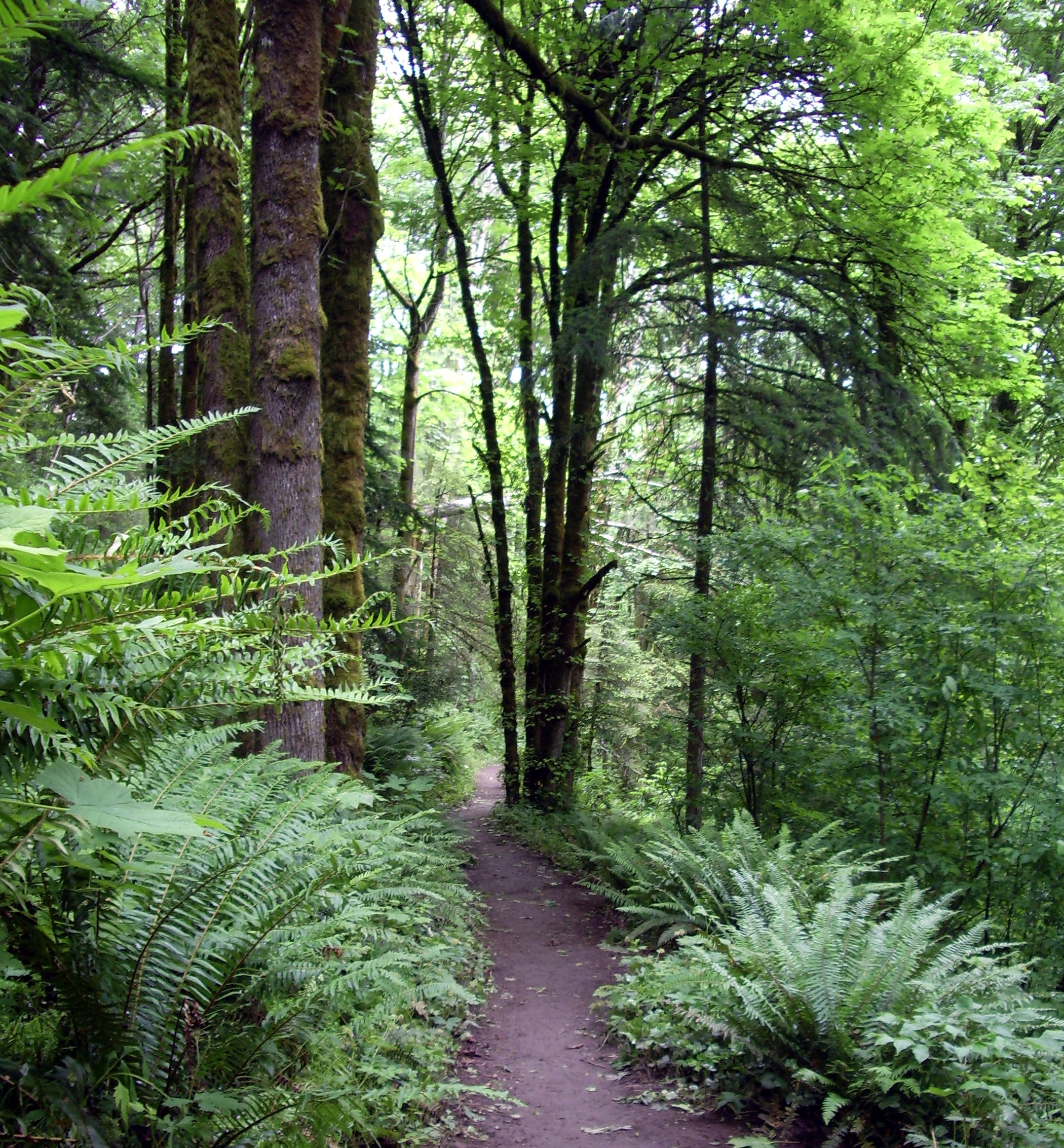
Understory of an old-growth conifer stand showing the structural complexity created by fallen logs and diverse vascular plant cover. Source: Wikimedia Commons (CC BY-SA 3.0).
Colonnades: the lasting signature of nurse logs
As hemlock trees rooted on a nurse log grow, their root systems gradually surround and envelope the decaying log. When the log eventually collapses and disappears, a row of mature trees remains — their roots bridging the space where the log once lay, forming a structure called a colonnade. These rows of trees, elevated on arching root systems, are among the most recognisable features of old-growth hemlock stands in coastal BC valleys.
Colonnades are most prominent along creek corridors where large spruce or hemlock nurse logs aligned with the drainage channel created linear germination opportunities. The persistence of the colonnade pattern across centuries — long after the original log has fully decomposed — marks nurse log dynamics as a formative influence on stand structure.
Coarse woody debris volume and forest structure
Nurse logs represent one portion of the total coarse woody debris (CWD) pool in a forest stand. In old-growth coastal BC stands, the volume of CWD — including standing snags, fallen logs at all decay classes, and large root masses — can be substantial. This material constitutes habitat for cavity-nesting birds, amphibians, small mammals, and a broad range of invertebrates and fungi.
Second-growth stands managed for timber production typically have significantly lower CWD volumes than old-growth, both because of the shorter rotation periods (which reduce the time available for large logs to accumulate) and because of harvest practices that historically removed residual woody material from cutblocks. This reduction in CWD affects not only the nurse log pool but also the availability of the associated habitat structures throughout the stand.
Sitka spruce regeneration on nurse logs
Sitka spruce (Picea sitchensis) also germinates on nurse logs, though less consistently than hemlock in closed-canopy conditions. Spruce is more commonly associated with exposed mineral soil germination on windthrow mounds, and its seedlings require more light than hemlock to survive beyond the first growing season. On nurse logs in partial shade, spruce seedlings tend to be outcompeted by hemlock over time. In forest edges, canopy gaps, and floodplain sites with higher light availability, spruce nurse log regeneration is more frequent.
A nurse log is not a passive substrate. It actively mediates moisture availability, competitive dynamics, and the spatial distribution of the next cohort of canopy trees across decades.
References and further reading
- Harmon, M.E., Franklin, J.F. et al. — Ecology of coarse woody debris in temperate forests — Advances in Ecological Research, 1986
- Meidinger, D. and Pojar, J. — Ecosystems of British Columbia — BC Ministry of Forests, 1991
- Natural Resources Canada — Forest Ecosystems
- Wikimedia Commons — Old Growth Western Hemlock Forest
See also: Moss Layers on Coastal Slopes · Sitka Spruce–Hemlock Light Gradients