Coastal Rainforest
Understory
Moss layers, nurse logs, and Sitka spruce–hemlock light gradients on coastal slopes in Canada. A reference for understory ecology of the Pacific temperate rainforest.

Coastal rainforest, Kaien Island, British Columbia. Source: Wikimedia Commons.
What we cover
Three dimensions of understory structure
The understory of a coastal Sitka spruce–western hemlock forest operates across vertical layers: cryptogamic ground cover, coarse woody debris, and the diffuse light that filters through an uneven canopy.
Moss & Lichen Layers
Continuous cryptogamic mats — dominated by Hylocomium splendens, Rhytidiadelphus loreus, and Isothecium myosuroides — regulate moisture retention and provide the primary seedbed surface on coastal slopes.
Nurse Log Dynamics
Fallen Sitka spruce and western hemlock stems create elevated, well-drained germination microsites. Hemlock seedlings colonize decaying logs preferentially, forming the characteristic "colonnades" visible along creek corridors.
Canopy Light Gradients
The mixed Sitka spruce–hemlock canopy transmits 2–8% of full sunlight to the forest floor in closed stands. Gap disturbances from windthrow temporarily shift this range, triggering distinct shade-tolerant and gap-responding assemblages below.
Articles
Recent documentation

Moss Layers on Coastal Slopes: Structure and Function
How continuous cryptogamic mats shape water retention, seedbed conditions, and microclimate in the Sitka spruce–hemlock zone of British Columbia.
Read article
Nurse Logs and Understory Regeneration in Coastal Hemlock Stands
Fallen stems as germination microsites: decay stages, colonization sequences, and the role of nurse logs in maintaining species composition.
Read article
Sitka Spruce–Hemlock Light Gradients on Coastal Slopes
Canopy transmission values, gap formation, and the understory plant communities that respond to shifting irradiance along topographic gradients.
Read articleEcology overview
The coastal slope context
The coastal temperate rainforests of British Columbia occupy a narrow band between the Pacific coast and the western slopes of the Coast Mountains. Annual precipitation in these zones commonly exceeds 2,000 mm, delivered largely as rain in lower elevations and as snow above 600–800 m.
Within this system, Sitka spruce (Picea sitchensis) and western hemlock (Tsuga heterophylla) co-dominate. Spruce tends to occupy the wetter, more disturbed sites — floodplains, fog-influenced headlands, and areas with mineral soil exposed by windthrow. Hemlock tolerates a broader range, including deep shade and nutrient-poor conditions.
The understory beneath their combined canopy is among the most species-rich bryophyte communities in North America. On steep north-facing slopes and concave terrain that accumulates cold air, moss depth can reach 15–20 cm above mineral soil, effectively isolating tree roots from ground frost.
Sword fern (Polystichum munitum), deer fern (Blechnum spicant), and wood sorrel (Oxalis oregana) are characteristic vascular understory plants that tolerate the low-light, high-humidity conditions of mature closed-canopy stands.
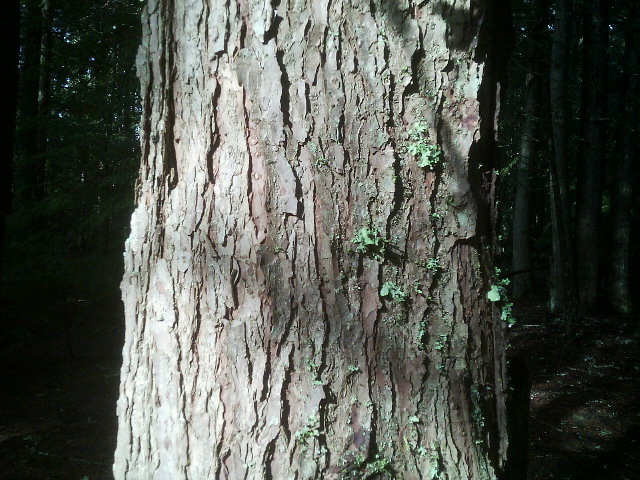
Western hemlock bark with lichens, inland temperate rainforest, Slocan Park, BC.
Characteristic species
Sitka spruce · Western hemlock · Sword fern · Deer fern · Wood sorrel · Skunk cabbage · Hylocomium splendens · Rhytidiadelphus loreus
Understory plants
Common ground-layer species

Deer Fern
Blechnum spicant — Evergreen fern with two distinct frond types: sterile fronds spread horizontally in shade; erect fertile fronds rise above to release spores. Common on moist, humus-rich slopes under hemlock canopy.

Wood Sorrel
Oxalis oregana — Low-growing herb forming dense mats across the forest floor. Leaflets fold downward under high light exposure, a direct behavioural response to irradiance. A reliable indicator of humid, shaded conditions.

Sword Fern
Polystichum munitum — The most abundant vascular understory plant in coastal hemlock and spruce stands. Individual clumps can persist for decades; root crowns of mature specimens are often elevated above the general soil surface on nurse log remnants.